The energy transition is rapidly reshaping urban life in Amsterdam. Heat pumps for centuries-old buildings, solar panels on rooftops, and electric vehicles in the streets. The city is witnessing a system upgrade, and this new “hardware” sends the message: fossil fuels out, sustainable energy in.
This article was featured in the AMS Impact Digest 2025-2026
But Amsterdam’s goals of phasing out natural gas by 2040 and reaching climate neutrality by 2050 take more than just technology. It takes a resilient, just, and regenerative energy transition. AMS Institute and its partners work on a fundamental shift with the following dream: transforming urban energy systems into decentralized, inclusive networks where neighborhoods actively produce, share and manage energy.
“A resilient, just and regenerative energy future is not a technical challenge alone. It is a systems question at the heart of how cities evolve”
Maike Simmes
Strategic Programs & Institute Secretary
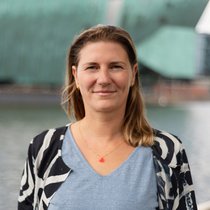
Maike Simmes, one of AMS Institute's Strategic Program leads, underscored that “broad prosperity, social equality, and health are all at stake. Think of people living in cold, poorly insulated homes, facing higher costs and worse outcomes. The energy transition must address all of this, not just the grid.”
AMS Institute and its partners work on transforming urban energy systems into decentralized, inclusive networks. Two projects show what blending the technical, social, and spatial planning aspects of that can look like in practice.
ATELIER: Designing positive energy districts
One of the sharpest tests came through ATELIER, a 6.5-year EU-funded project exploring how urban neighborhoods can become Positive Energy Districts (PEDs)— areas that generate more energy than they consume. The goal: actively contribute to grid stability and a resilient energy system. The collaborative governance structure connected the City with knowledge institutes, industry partners, communities, and innovation networks to accelerate the local energy transition.
Amsterdam Living Labs: Poppies and Republic
Amsterdam was one of two ATELIER 'Lighthouse Cities'. AMS Institute, TNO, and partners supported the City in establishing successful Living Labs (Innovation Ateliers) at two newly built mixed-use developments in Amsterdam Noord, Buiksloterham: Poppies and Republica. Both served as real-life testing environments for Positive Energy District solutions, combining all-electric infrastructure, smart grids, solar panels, flexible energy systems, and shared community spaces.
“The pilots themselves proved important for validating a set of solutions, but it was establishing the innovation ecosystem and governance structures that created an extended impact, learning from the experimentation independently of whether the experiment worked or not.”
Juanita Devis Clavijo
Urban Living Lab Developer
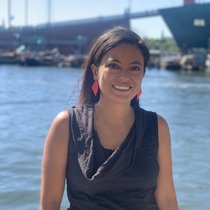
For example, one experiment that failed was the battery planned for Republica. During implementation, the development faced Signiant grid congestion and therefore received a fraction of its requested connection capacity. But thanks to TNO’s digital twin developed early on, the project team was still able to simulate system performance and optimize the control of flexible assets, including battery systems. Republica demonstrated that operating within grid constraints is possible through the combination of a smart Energy Management System (EMS), flexible energy assets, and a multimodal heating system. The lessons are all carrying over beyond the project.
“What ATELIER made very clear is that the energy transition has to be designed into such a neighborhood from the start. It is about technology, but also about ownership, nuancing, collaboration, and trust,” mentioned Sarah Bork, Head of Innovation at the Municipality of Amsterdam. “As a municipality, the next step is to take what worked in Buiksloterham and build it into the everyday practice of area development, so innovation can move from one exceptional project to many places in the city.”
ATELIER tools: Technical innovation alone is not enough
To support cities and practitioners across Europe in advancing similar transitions, the ATELIER project developed a set of practical resources, including the PED Planning Guide, the Innovation Atelier Guide for setting up multi- actor collaboration structures, and a Best Practice Booklet. Cities can access courses through the PED Learning Platform, designed to support capacity building and the wider energy transition.
Subsidies, energy coaching, or renovations?
While ATELIER worked at the scale of districts and grids in Amsterdam Noord, AMS Institute researcher Joe Llewellyn went door to door for a Living Lab called Energie Lab Zuidoost (Energy Lab Southeast), co-led by AMS Institute, a coalition of universities, and the City.
“We were interested in what the effects of two of our policies — energy coaching and subsidies — would have on the energy bills of households. And how that difference compares with a newly-renovated house, to clearly see what policy works best,” said Dian Kroes, policymaker at the Municipality of Amsterdam who initiated the project.
“Energy coaching helps residents save more money, and renovations are better at reducing gas usage.”
Joe Llewellyn
Former Research Fellow at AMS Institute
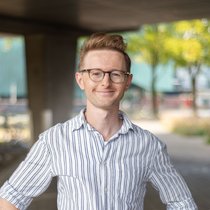
Two AMS Institute projects investigated the differences. Llewellyn visited nearly 370 homes, thermal camera in one hand, LiDAR scanner in the other, to understand what the energy transition actually looks like from inside a poorly insulated flat belonging to a low-income household. What he found was a trifecta of pressure: rising bills, homes that cannot hold heat, and residents making ends meet.
His work, alongside the MIT Senseable City team at AMS Institute, found that government subsidies had little impact on energy poverty, which affects 500,000 homes in the Netherlands. Energy coaching — a volunteer visiting residents at home, giving advice and building knowledge — reduced bills by around 90 euros per month. Renovations (new insulation materials) reduced bills by around 110.
“In the winter the level of comfort skyrocketed,” said resident Jim Alderden. “It is nice to have lower bills. And for me, and I think for most people, to feel such an improved comfort level in your own house is so important.”
“We now use the findings as Stadsdeel Zuidoost in our collaboration with different departments where we try to implement these finndings in our policies. For now, we are advocating for energy coaching in renovated buildings to stimulate reducing energy consumption even further,” Kroes said.
Every house call traced the experience of residents such as Jim Alderden, who applied the tips and equipment offered by Llewellyn’s energy coaching. Video by Jan Mazur
Energie Lab Zuidoost
Energie Lab Zuidoost and the AMS Institute Urban Energy team work to form inclusive and equitable energy systems. “Our projects connect research with policy, but they also include community members as we conduct real-world experiments on how energy is created, used, stored, and shared,” said Dorus Stokhof, Program Developer for Urban Energy at AMS Institute.
“ELZO is a unique structure for continuous, place-based research. Every researcher who comes in builds upon what came before,” program manager Annoesjka Nienhuis from the City's Innovation and Sustainability department added. Each step serves to accelerate the energy transition, while “the knowledge stays, the relationships stay — because we look at both the technical and the just side of the transition, together with local partners, government, and knowledge institutions.”
“Bridge builders are trusted people in the community that translate information, reduce fear, and reach residents in ways the municipality can't,” said Aman Walia of ELZO’s Groene Hub Living Lab. When collaboration or the energy transition prove difficult, labs like ELZO are designed to keep going long after any single grant cycle ends. Ellen Nieuweboer from Municipality of Amsterdam elaborated that “to apply these innovations in practice, you need a droplet first. Only then can you create a ripple effect.”
ELZO's backbone is a manifesto shared by the City of Amsterdam, AMS Institute, Urban Energy Institute TU Delft, Hogeschool van Amsterdam and the UvA that all researchers working in Zuidoost have signed, committing them to build on preceding work, generate tangible value, and give back to the community. When one researcher moves on, the knowledge, relationships, and trust remain. Over time, ELZO’s focus has expanded to include circular construction and climate adaptation, reflecting the reality that in a neighborhood like Zuidoost, these challenges cannot be separated.