Public spaces are under growing pressure from events, tourism, and daily traffic. Around hot spots and public transport hubs, this leads to crowding, not just among pedestrians, but increasingly among cyclists too, compromising safety, comfort, and traffic flow. As public space itself is finite, AMS Institute has spent more than a decade helping Amsterdam and other growing cities keep things running safely and smoothly.
Since 2015, AMS Institute, together with TU Delft, has collaborated with the City of Amsterdam to monitor and analyze pedestrian and cyclist movements (active modes) in the city. The work began with a prototype: during SAIL 2015, one of the world's largest outdoor events, pedestrian flows were monitored and visualized in real time for the first time. Data from cameras, Wi-Fi, social media, and GPS were used to generate insights into density, speed, travel time, and sentiment, demonstrating the practical value of crowd monitoring.
From research to real-world impact
This laid the foundation for an ongoing ecosystem of collaboration, leading to new research projects such as Allegro, Think Fast Go Slow, and CityFlows, which modeled pedestrian and cyclist flows, tested sensor technology, and developed decision-support systems. This research underpinned the Crowd Monitoring System Amsterdam (CMSA, in Dutch, LVMA), which is now further developed and operated by the City of Amsterdam. Current-day examples include use at events such as Kingsday or concerts at Johan Cruijff Arena and day-to-day monitoring at the 'De Wallen' area. The CMSA also laid the groundwork for the systematic rollout of similar crowd safety systems now operating in cities worldwide, for locations where crowd safety could be at risk due to high density or peak demand.
This research connects directly to the City's spatial policy. In 2023, the City of Amsterdam stated in the strategic framework Amsterdam maakt ruimte (Amsterdam Makes Space) that it aims to create more space for its residents. Alderman for Mobility Elise Moeskops: "Public space only truly serves its inhabitants when it's not only a place to get from A to B but also serves as a space to meet and interact. For that to happen, we need to slow down our city and create space for people."
New tools for a shared public space
The growing ambition to make space for pedestrians and cyclists has also broadened the scope of research, leading to proven pilots that directly improve walkability and pedestrian flow in cities. Tools developed within DRO-DMI (a consortium that AMS Institute is part of, which helps public organizations digitally orchestrate the use of public space) allow planners to model pedestrian flows, assess street walkability, and allocate scarce public space more effectively. In the City of Almere, this feeds directly into the redesign of the city center. Stef Klompmaker (data analyst): "It is incredibly useful to know where people walk, so that you can target specific measures to those locations, whether it concerns social safety, installing additional lamp posts, or planting trees."
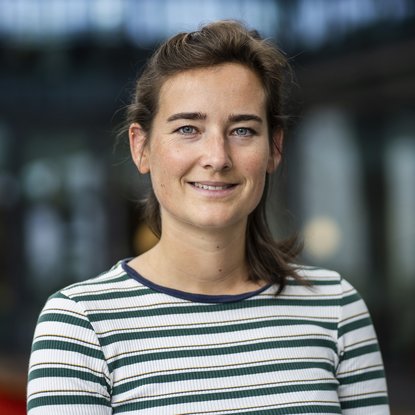
Crowd monitoring systems now help cities safeguard public safety as urban spaces grow more crowded. "Since 2015, these systems have helped us better track how pedestrians and cyclists move, with behavioral analysis deepening our understanding of what matters to them in public space," explained Dorine Duives, Director of the Active Mode Lab at TU Delft. During the most recent edition of SAIL, this work continued with various data collection methods tested once more, including new approaches on the water. "It gave practitioners confidence that these innovative systems could make a difference when it mattered most."
Duives also noted that we've only seen the tip of the iceberg. Questions remain: why does the Netherlands have so many single-bicycle accidents? How do we make pedestrian infrastructure accessible to everyone? Looking ahead, Duives argues that the challenge of the next decade is not whether we can measure ever more intelligently, but whether we do so responsibly. "With AMS Institute, TU Delft is working on crowd management systems that contribute to safety, while privacy, transparency, and societal values are central from the design stage onward. Responsible use should not be an afterthought, but the starting point."