Across keynotes, lab deep dives, and discussions, one conclusion consistently surfaces: impact does not result from consecutive actions, but emerges through interaction between people.
Interpreting impact
A dominant assumption in how impact is often understood is that it can be attributed to a single actor: a project, an intervention, a person. However, keynote speaker Theo Niessen emphasized relational understanding of impact, rather than a linear one: “the basis of making impact is interaction”. What matters is not only what is initiated, but how others take it up – whether it is shared further or translated into action – and how it resonates, evolves, and connects across contexts.
This also redistributes responsibility. Instead of focusing on optimizing individual contributions, the emphasis moves toward creating the conditions in which interaction can happen: spaces for dialogue, openness to multiple perspectives, and allowing adaptations over time. Impact becomes cumulative, built through many small moments rather than a single decisive action.
A learning alliance in the energy transition
The energy transition in Amsterdam Zuidoost is complex, combining infrastructure, social realities, governance, and lived experience. No single actor can address it alone. Maike Simmes (AMS Institute) and Annoesjka Nienhuis (Municipality of Amsterdam) lead the Energy Lab South East and hosted the seminar. They highlighted that the platform brings residents, researchers, government, and market parties together within living labs that link research directly to real-world practice. A shared manifest forms the basis for researchers, committing them to generate tangible value for the neighborhood, build on preceding efforts, and give back to the community.
These labs operate at the intersection of multiple challenges. The energy transition is deeply connected to other spatial and societal issues, from circular construction to climate adaptation. Addressing these interdependencies requires an integrated approach from the outset, aligning technical, social, and institutional perspectives rather than combining them separately. This is reflected in the expansion of ELZO’s thematic focus to include circular construction and climate adaptation in its living labs. Over time, this multi-faceted, interdisciplinary approach will drive not only knowledge but also a longer-term impact network necessary for broader scaling-up of interventions.
From pilot to policy: multiple perspectives
As part of the seminar program, Zwanet van Lubek (AMS Institute) moderated a panel discussion that brought together Vincent de Kom (Municipality of Amsterdam), Ellen Nieuweboer (Municipality of Amsterdam), and Robert Geerlings (Beyond Bims) to explore how impact is created in the neighborhood, the challenges this entails, and their perspectives on future opportunities.
A key insight is the importance of involving stakeholders from the very beginning. Solutions cannot be developed within silos and combined later; they need to be coordinated early, with all relevant actors involved. Without this, implementation becomes significantly more difficult.
“We need to move from new public management towards new public governance. This represents a different way of organizing politics and decision-making. The key question is: how can we scale up? How can we integrate these lessons from the outset? It’s crucial to take a holistic approach, considering not just the technical aspects, but also the impact on the neighborhood and its residents.”
Vincent de Kom (Municipality of Amsterdam)
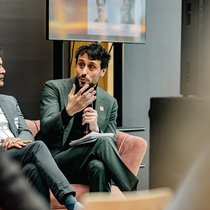
This also requires a shift in mindset. Working across disciplines and sectors calls for openness, flexibility, and a willingness to adapt. Sustained interaction is key: the energy transition demands more than a one-time alignment.
“In daily practice, if you want to get things done, it helps to know the relevant parties – and for them to know you. Knowing each other builds trust, and unfortunately, sometimes trust may even matter more than quality.”
Robert Geerlings (Beyond Bims)
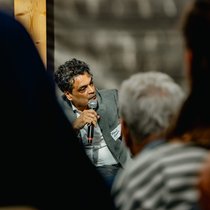
Collaboration is not a one-time alignment but a continuous practice. It depends on regular interaction, clear agreements, and the ability to adapt along the way. Working across disciplines and sectors also requires a specific mindset: combining commitment with openness, and actively seeking out different perspectives.
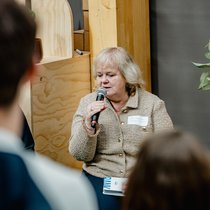
“Both aspects – innovating and connecting – are equally important. We’re seeing that in action: getting senior officials from ministries involved is impressive; but why does it work? Because meaningful innovations are happening. The most powerful part, in my view, is that these innovations are actually applied in practice. That’s the real strength of Energy Lab South East. You need a droplet first, only then can you create a ripple effect and generate wider impact.”
Ellen Nieuweboer (Municipality of Amsterdam)
Conclusion: impact is collective work
Across the seminar, a consistent understanding took shape. Impact is a process that develops over time, through relationships between people. It depends on interaction rather than individual action, on coalitions rather than isolated efforts, and on continuous engagement rather than one-off interventions.
The Energy Lab South East does not aim to be the sole driver of impact, but as the ecosystem in which impact can emerge. Lab leads and participants underscored its importance as a space that connects stakeholders and anchors strong, practice-based research in real-world contexts.
Acknowledgements
The seminar took place at OBA Next in the heart of Amsterdam Zuidoost: a library reimagined as a space for connection rather than collection, and a fitting setting for a conversation centered on learning and working together. The Energy Lab South East would like to thank everyone who actively contributed to the seminar:
- OBA Next Lab Kraaiennest – Brian Olensky, Nassima Samir, Aniel Nazarali, George O. Janssen, and OBA Guides, for hosting and supporting the space.
- Maike Simmes (AMS Institute) and Annoesjka Nienhuis (Gemeente Amsterdam) for connecting the perspectives across the seminar.
- Theo Niessen (Fontys Hogeschool) for the keynote on impact in practice-oriented research.
- Labtrekkers of ELZO – Else Veldman, Dorus Stokhof, Gerard Roemers, Bas Horsting, Imrat Verhoeven, Stan Majoor, Renee Swinkels, Gerben Mol – for leading deep-dives on the four Energie Lab Zuidoost themes: Rechtvaardige Energietransitie, Duurzame Energiesystemen, Circulair Gebouwde Omgeving, and Klimaatadaptatie.
- Ellen Nieuweboer, Robert Geerlings, and Vincent de Kom for contributing their valuable insights in the panel discussion, and Zwanet van Lubek for moderating it.
- Else Ferf Jentink and John Grin for contributing their stories and reflections.
ELZO also thanks its structural partners for their ongoing support: neighborhood organizations !WOON, EGK Centre, Groene Hub, Mama Florijn and others (to many to mention here); housing corporations Ymere, Rochdale, Eigen Haard, Stadgenoot, Lieven de Key; and neighborhood partners Energietransitiecomissie Geerdinkhof, ECHO, Johan Cruijff ArenA, Hart voor de K-buurt, OBA Next Lab, Zuid Oost Future Makers and many others.
And, last but not least: everyone who joined the seminar. Your engagement brought the Energy Lab South East themes to life and made this seminar on collaboration and impact possible. If you want to stay informed about future seminars, subscribe to the newsletter (in Dutch) here.