In a study published in Nature Scientific Reports, researchers from MIT Senseable City Lab, TU Delft, and AMS Institute demonstrate how GPS data from buses and trams, combined with detailed demographic data, can contribute to environmental measurements that are more representative of the living conditions of different groups of city residents. With a limited number of mobile sensors, cities can thus gain greater insight into the exposure of different groups of residents to air pollution.
The researchers have also developed an interactive online dashboard. Through fair-sensing.com, municipalities can simulate scenarios themselves and calculate how many vehicles and specific routes are needed to achieve fair environmental monitoring in their city.
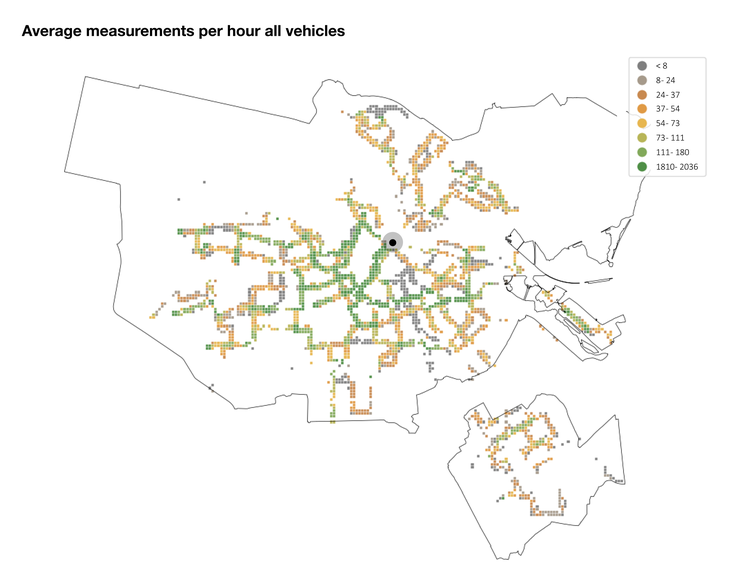
Figure 1: Average measurements per hour cell in Amsterda, during a 24-hour period on Wednesday, assuming all vehicles are equipped with sensors.
As cities increasingly invest in quality of life and tackling air pollution, accurate environmental monitoring is high on the agenda. To assess health risks from, for example, particulate matter and nitrogen dioxide, Dutch cities have traditionally relied on fixed monitoring stations. These static sensors leave blind spots in certain areas and are not always representative of the diversity of the urban population.
Fixed Monitoring Stations
In Amsterdam and other cities in the Netherlands, monitoring is conducted using fixed sensors in accordance with legal guidelines. These provide valuable insights but are very localized. Given the demographic variations within a city, they often cover only a small portion of the population. To make the measurements more representative of the urban population, MIT, AMS, and TU Delft investigated the potential of adding mobile sensors to buses and trams. Using CBS data on a 100-by-100-meter grid, they analyzed coverage across different population groups, categorized by age, migration background, and property value (WOZ).
If just six vehicles are equipped with sensors, they would represent 17.6% of all Amsterdam residents within 24 hours. Over the course of a full week, this coverage rises to 26.2% of the population. In addition, the sensors would collect more representative data, with the demographic background of the measured areas better reflecting the citywide average.
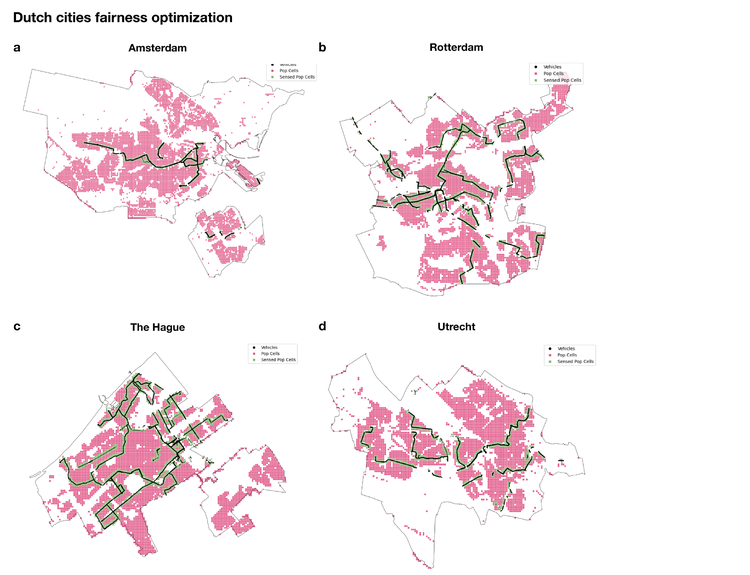
Figure 2: The fairest distribution of monitoring points if 6 public transit vehicles equipped with sensors were to monitor air quality in Amsterdam, Rotterdam, The Hague, and Utrecht.
From Blind Spots to Fair Citywide Environmental Monitoring
According to a co-author Titus Venverloo (Program Developer at the AMS Institute and researcher at the MIT Senseable City Lab), cities still have much to gain in the area of social inclusion:
“Many cities could do a better job of ensuring that their monitoring systems adequately account for all population groups. When placing sensors, there is a risk that air pollution affecting specific groups will be overlooked. By expanding the monitoring network to include sensors on public transportation in addition to fixed sensors, we are taking another step toward building a fair and comprehensive environmental monitoring network.”
The lead author Petar Koljensic (a researcher at TU Delft, MIT, and the AMS Institute) emphasizes that cities with a limited number of vehicles can already achieve enormous gains:
“With a selection of 20 equipped vehicles, virtually the entire accessible city can be monitored in a demographically sound manner. It’s not about installing thousands of expensive sensors, but about strategically deploying the mobile sensors on the right routes.”
Petar Koljensic
Research Fellow

Immediately scalable to other cities
To support urban planners and policymakers, the researchers have developed an interactive online dashboard. Through fair-sensing.com, municipalities can simulate scenarios themselves and calculate how many vehicles and specific routes are needed to achieve fair environmental monitoring in their city. While the current analysis focuses on air quality, temperature and noise levels could also be measured.
The message of the study is clear: effective environmental monitoring does not necessarily require more fixed sensors, but rather a smarter use of the existing network and public transportation. As a follow-up study, sensors are now being installed on public transportation in Rotterdam. Results from this study are expected in two months.
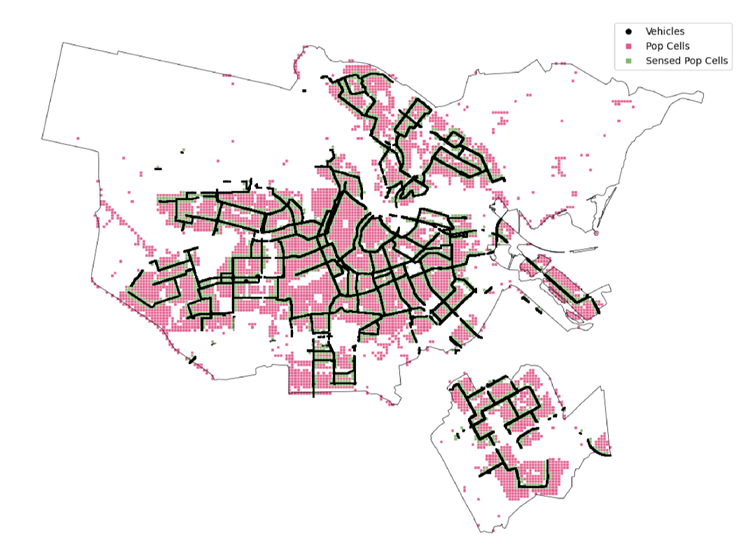
Figure 3: Coverage of Amsterdam’s population by 6 sensor-equipped buses and trams, optimalized for maximal special coverage, reaching 46.6% of the population.