It's a common sight in Amsterdam: cigarette butts flicked onto the street, discarded food wrappers lodged between parked bicycles, and packaging blowing into the water. The city loses an estimated 16 metric tons of plastic (1.9 million items) to the IJ River every year.
A four-year project called Solving the Urban Plastic Soup that culminated in 2026 monitored 20 locations across the city's canal network for the most granular picture to date of what types of plastic Amsterdam is losing and where. It also showed how two innovations capturing small plastic pollution proved effective enough that the City of Amsterdam adopted them into its permanent infrastructure.
As the project name describes, floating plastic accumulates into a soup in certain corners or under bridges all over town, much of it blown into the water by the wind. Managing the entire water chain for 1.4 million residents, Waternet has four boats that dredge several thousand kilograms of trash daily. Researchers from Wageningen University & Research at AMS Institute recorded an estimated 3.67 items still entering the IJ River every minute (that's 5,280 items per day).
Researchers also listed the most abundant types of plastic: food wrappers lead the count at over one-fifth of all items, followed by foam fragments, soft plastic fragments, cigarette filters, drink cans, bags, bottles, food packaging, small bags, and caps and lids. "These account for 80% of all floating objects, and all represent single-use products, designed to be discarded," stated the project's paper, Plastic pathways and intervention strategies in urban water systems (Environmental Challenges, June 2026).
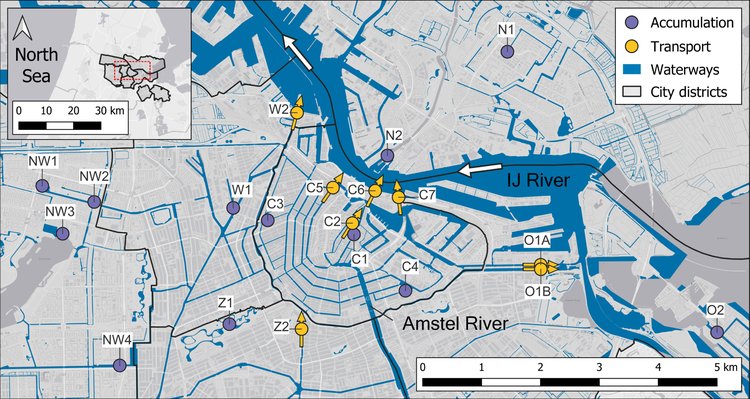
A map of monitoring locations in the study area. Yellow circles indicate locations where plastic flowed through, purple circles show accumulation locations. The yellow arrows show the main transport direction of the plastic, the white arrows indicate the flow direction of the IJ river into the North Sea. The first letter of each monitoring location indicates its city district.
Certain spots became living labs throughout Amsterdam, testing how best to collect the smaller, floating pollution that Waternet's dredging boats are missing. This phase brought together three clever devices that collect floating plastic waste, the Shoreliner from TAUW, Noria's CanalCleaner, and The Great Bubble Barrier's Bubble Barrier — installations that use wind, a curtain of bubbles, currents, or flow to direct waste into cages.
Actively capturing waste
So far, Amsterdam has implemented one Bubble Barrier and one CanalCleaner. The City will purchase and place more such devices in the near future.
The team first predicted the cages would need emptying only once per month, but in actuality, "we empty the CanalCleaner and Bubble Barrier three times a week using our waste collection boat," said Jonathan Guijt, Operations Manager for Waternet. "It's a straightforward process. We pull up alongside the installation, lift the collection cage with a crane, empty it into the boat, and clean up whatever's floating around it with landing nets."
A boat crossing the Bubble Barrier. © The Great Bubble Barrier
While the waste problem persists, installing effective devices to combat it marks a triumph for the Plastic Soup consortium: strategic collection, interception, and retrieval in the city's waters is working. "We didn't expect to collect this much waste at that location," said Joris Wiggins, Noria Project Lead and Engineer, whose CanalCleaner can be seen under the bridge on the eastern flank of Centraal Station. "Seeing how much plastic accumulates each day creates a sense of urgency. It pushes municipalities to allocate funding for a problem that was literally underwater until now."
"Their strategic placement, visibility, and emotional appeal also educate and motivate the public to take action," noted Anne Marieke Eveleens from The Great Bubble Barrier, which continues to collect 80 kg or 15,536 pieces of inorganic debris per month from its permanent location at Westerdok.
“Their strategic placement, visibility, and emotional appeal also educate and motivate the public to take action.”
Anne Marieke Eveleens, Co-Founder of The Great Bubble Barrier
Stopping plastic before it reaches the water
"This project helps us understand how big the plastic waste problem in our waterways is and how we can fix it at the end of the pipeline," said Lotte Geeraedts, Sustainability Specialist at the City of Amsterdam. But collection only treats the end of the pipeline. The longer items stay in the water, the more they break down and become unrecyclable. The project's researchers map seven interventions across a plastic item's life cycle, only two of which happen at the end (see text box on the next page).
Dredging bulkier waste from the water costs Amsterdam €3.2 million annually. The broader socioeconomic and environmental costs of plastic pollution, including biodiversity loss, damage to ships and hydraulic infrastructure, and disruptions to shipping, remain largely unaddressed. Reaching the City's 2030 target of drastically reducing plastic leakage will require simultaneous action across the full life cycle, which is why the project targeted every stage and involved government, researchers, stakeholders, and contractors.
Amsterdam now has something it lacked three years ago: more devices removing plastic waste from its waterways, an understanding of plastic pollution hotspots specific to Amsterdam, and a set of tools: a flowchart to determine which collection device is best suited to a specific location, a decision-support tool to help prioritize collection interventions, and a set of policy and regulatory recommendations focused on prevention.
"The result is a methodology that is documented, tested, and ready to be applied elsewhere," said Francesca Alberti, Project Manager at AMS Institute. "Other cities with similar waterway systems don't need to start from scratch. We are sharing our data, the monitoring methods, the intervention framework, and tools to assess who is accountable and divide tasks." Each of these could prove valuable for any port or gateway city like Rotterdam, The Hague, London, Paris, Bangkok, Singapore, and Melbourne.
AMS Institute project coordinator Francesca Alberti and Noria engineer Joris Wiggins inspect the waste captured by the Canal Cleaner on the east side of Amsterdam Central Station. © Alex Schröder