Microplastics are very hard to see. Classified as pieces five millimeters or less, particles from 300 micrometers are about the size of a dust mite and just visible to the naked eye. Only with a special microscope and software can scientists observe particles of 20 micrometers, the size of a human skin cell.
So how do we visualize and cope with something so minute yet so omnipresent, from clouds and wildlife to the human blood-brain barrier? For their living lab project, urban engineers from the MSc MADE program created an atlas mapping plastic pollution, what we can do to avoid it, and who interacts the most with it.
The microplastics atlas
The atlas the students created is a page-turner. Microplastics: Tiny, But Toxic: An Atlas on People’s Concerns of Microplastics contains gems from “toxicity menders,” those researching, countering, mitigating, or mending chemical harm that the team interviewed during cocreation sessions. The bottom line: a world entirely free of microplastics is no longer a viable reality.
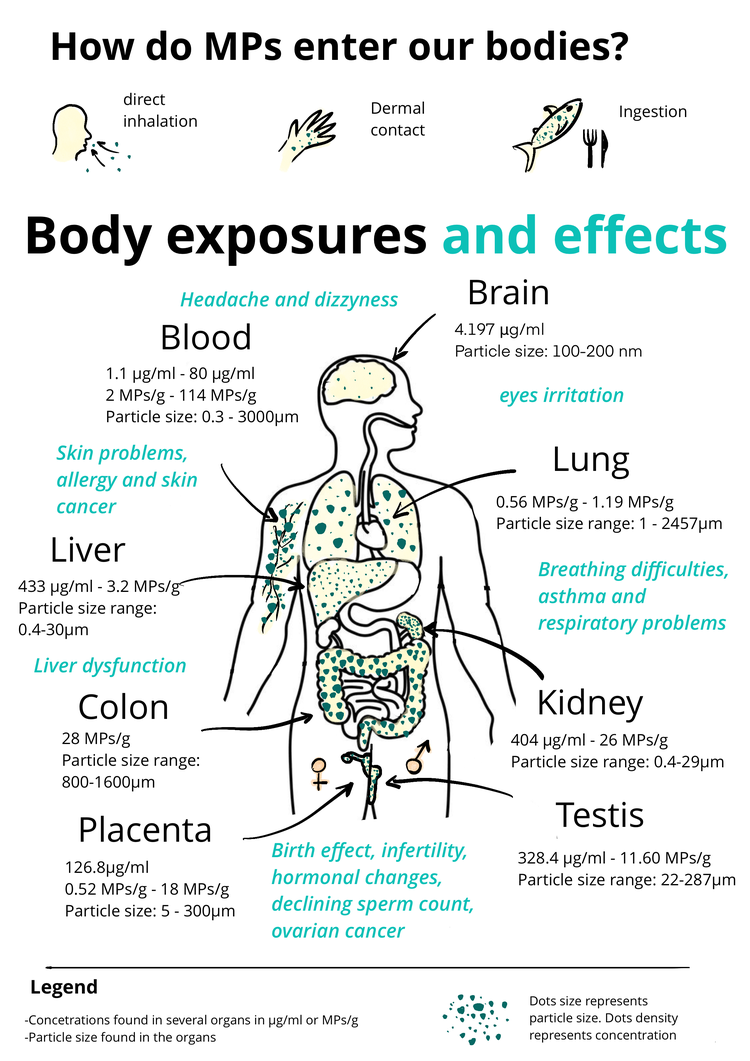
The Atlas illustrates the unavoidable: microplastics in the human body.
Rich with facts and where we encounter it in daily life help navigate its presence:
… the first plastic, celluloid, was invented in 1869 as an alternative to ivory for the billiard industry.
… between 1950 and 2017, the world produced 9.2 billion metric tons of primary plastic. This is roughly equivalent to the weight of 1.2 billion elephants or 900,000 Eiffel Towers.
… many tea bags are made of polypropylene (PP) and heat-sealed with PLA, which releases particles directly into the hot water you drink.
… and using a plastic cutting board can lead to an estimated ingestion of 7.4 to 50.7 grams of polyethylene per year simply through the act of slicing food on the surface.
Why did they make it?
Plenty of scientific data exists on microplastics, but it often fails to connect to the social and economic factors that limit our ability to reduce harm from this permanent part of our lives. That is why the Embodied Ecologies project, the case initiator, put MADE students Jelle Biegel, Robert Laan, Marthe Meijer, Pietro Nicolini, and Charlotte Schmitt to task. It allowed the team to leverage the multidisciplinary skills in engineering, social design, and systems thinking they learn over the course of the two year program.
Embodied Ecologies is coordinated by the University of Wageningen Social Science Group. It explores how people sense, know, and act to reduce their exposure to chemicals. The students combined the Living Lab Way of Working with Embodied’s methodology, combining ethnography (documenting what people feel, do, and know) with experimental cartography. This bridges the gap between traditional scientific research and lived experience.
Living Labs can inform Atlases, too
The team used the Living Lab framework to make the largely invisible threat of microplastics tangible for everyday people. They began with expert interviews and a literature review covering global production flows, health impacts, and existing legislation, then moved into a series of co-creation workshops.
Read more about their process on the project's dedicated website.
Participants spanned a wide network: Amsterdam and Texel residents (the latter having a strong connection to marine plastic pollution), policy makers, environmental scientists, and microplastics high-risk individuals including nail salon workers and pregnant women. Collaborating organisations ranged from GGD Amsterdam and Wageningen University & Research to The Great Bubble Barrier (an AMS Institute partner whose (micro)plastic capturing device is used by the municipality) — over thirty stakeholders in total.
Another session mapped participants’ household encounters with microplastics room by room, sketching or annotating templates of kitchens, bathrooms, and living spaces. Seven thematic categories that arose — Systems, Health, Sources, Animals, The Permanently Polluted World, Solutions, and Mediums — formed the structural backbone of the Atlas. A final co-evaluation phase brought in experts to review and validate the visualizations.
“The cocreation sessions were the most valuable part of this experience for us, as we realized we were able to collect incredibly relevant and insightful data for our research just by organizing effective sessions with residents and experts,” said Charlotte Schmitt of the living lab methodology, which strives to capture multiple perspectives.
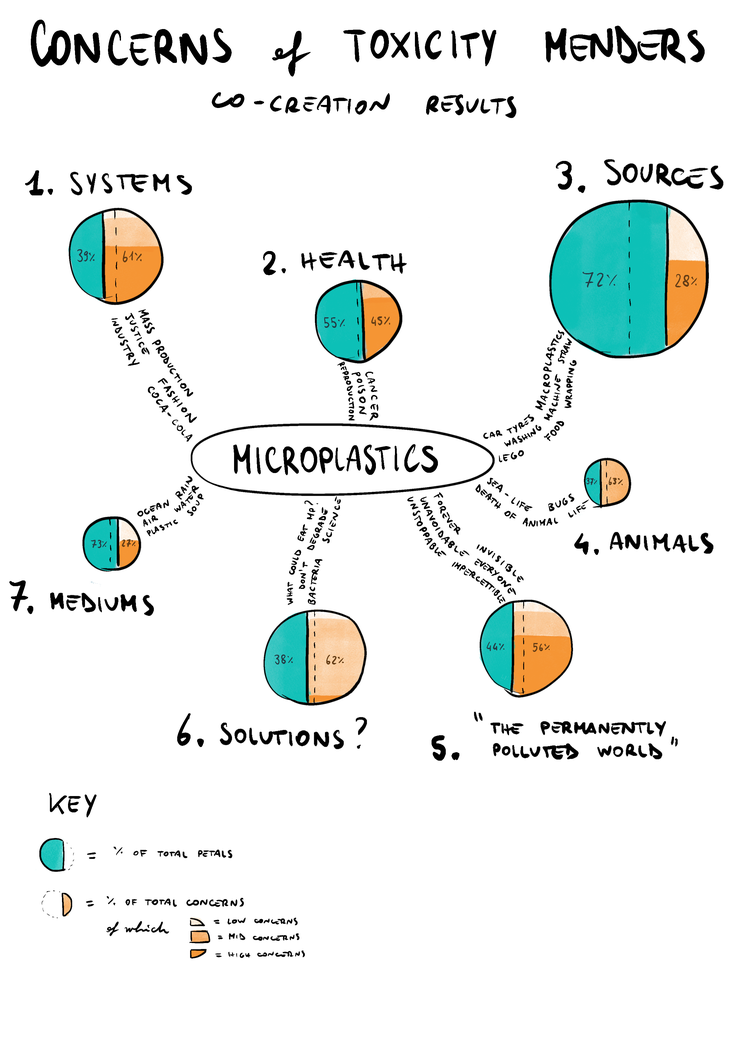
The Flower Association Exercise allowed the team to process concerns into distinct categories
Where are they now?
Modern engineers must navigate a topic’s multilayered complexity — with tools at the intersection of technical, social, and environmental systems the team uses today in their professional lives.
Robert Laan has moved into a position as an Intern for Environmental Impact Assessment at Sweco. Charlotte Schmitt is now the Executive Director at Young Urban Engineers, shaping fresh perspectives on urban challenges. Pietro Nicolini is now setting his ground to become a technical creative consultant together with partners from the made program while preparing to launch his own entrepreneurship initiatives. Marthe Meijer is working as a Project Assistant for the renovation of Amsterdam’s canal walls. Jelle Biegel is now doing an internship/thesis at the GGD where he investigates the influence of different food environment configurations on the food consumption of adolescents through agent-based modelling.
Robert Laan, Charlotte Schmitt, Pietro Nicolini, Marthe Meijer, and Jelle Biegel graduated from the MSc MADE program in 2025