AMS Institute’s Responsible Sensing Lab and Smart Doorbell Consortium are questioning whether the obvious appeal of smart doorbells — equipped with cameras, some with sound recording, and biometric capabilities — is overshadowed by erosion of public privacy and concerns over a growing mass surveillance society in which data is used by Big Tech and police departments.
Consortium researchers suggest that the most responsible way to install your new device is not solo, but instead to perform their Smart Doorbell Check together with neighbors. By reviewing these four critical questions, you provide neighbors with the peace of mind of knowing exactly how the camera is positioned and whether privacy filters are truly engaged.
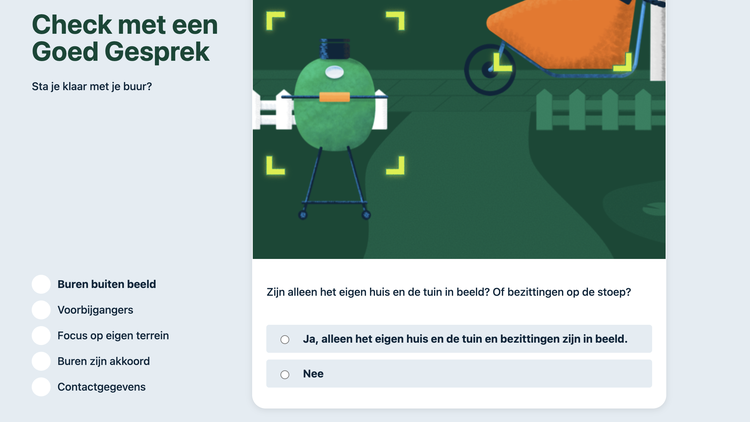
Smart Doorbell Check
- Is the doorbell’s camera not aimed at your neighbors’ property?
- Are the privacy settings turned on, and are passersby invisible?
- Are you recording only your own home and garden and not public spaces?
- Is your neighbour aware of and satisfied with your doorbell’s settings?
Answer yes, and receive a sticker to post alongside the camera, a sign that you took neighbors’ privacy into account, and they are aware of how the smart doorbell is being used and what it records.
In the United States, new "AI doorbells" are already being flagged as harbingers of a potential "surveillance nightmare," Amazon's camera earning a spot on a "Worst in Show" list at the Consumer Electronics Show (CES) 2026 for intrusive facial recognition features and general privacy invasion.
In the Netherlands, enforcing GDPR legislation is difficult for the Dutch Data Protection Authority (AP) due to the sheer volume of devices. But in select cases, Dutch courts have ruled that the interest in protecting one's property does not justify infringing on others' privacy on public roads, sidewalks, parks, or parking lots that come into view of the lens.
Despite clear legal boundaries, the Smart Doorbell Consortium's survey reveals a significant compliance gap: 90% of these cameras capture footage of public sidewalks or neighboring gardens. Research shows that many users are unaware of the social and privacy impact of smart doorbells and that conversations with neighbours about the bell hardly ever take place.
They note a double standard: while 75% of residents polled feel they should be informed before a camera is installed nearby, a mere 3% of owners actually initiate that conversation. This silence creates a culture of suspicion where two-thirds of citizens believe they have been filmed without consent in just the last month, and nearly 20% suspect their private conversations were caught on mic. Paradoxically, while 62% of users feel safer with the tech, the constant stream of movement alerts often has the opposite effect, increasing feelings of anxiety and hyper-vigilance.
The Smart Doorbell Paradox
The Privacy Gap
- 90% of cameras (mostly illegally) film public spaces
- 84% of owners have no warning signage
- 66% of neighbors believe they were filmed without consent
- 19% believe cameras recorded their conversation
The Communication Gap
- 75% of people want to be informed by neighbors that the camera exists
- 59% agree that they need to consult with their neighbours, yet…
- 77% of owners never informed their neighbors about the installation
- Only 3% of owners actually reached out
- Only 1% of neighbors recall being consulted
The Psychology Gap
- 62% feel safer, yet data suggests increased anxiety from constant movement alerts
- 44% of owners refuse to change settings, despite legal friction
- 42% of citizens support the idea of making smart doorbell use more privacy-conscious, yet…
- 44% of existing owners stated they would take no action to adjust their device
Many did not realize that some devices record audio in addition to video, that popular brands like Ring and Nest upload metadata and footage to servers outside the EU, or that they may hold onto recordings beyond the legal 4-week maximum (unless they contain evidence of a specific incident). From a social standpoint, seeing everything that happens through a camera often leads to a surveillance culture of increased neighbor suspicion, new conflicts, and a breakdown of trust and community cohesion.
To combat this, the consortium is investigating a blend of regulatory and non-regulatory solutions with partners. Regulatory exploration includes developing advice for new local regulations, working closely with the Dutch Association of Municipalities (VNG). The solution with the most traction (41%) among owners is displaying a sticker or sign to indicate filming is occurring (which you'd receive if you answered "yes" to the Smart Doorbell Check questions). Other ideas include plastic privacy lenses that blur the view (similar to reading glasses).
In terms of practical, non-regulatory design, the Responsible Sensing Lab has developed low-tech modifications like the 'Shutter' — a physical privacy lens intended to limit the camera's field of view and ensure privacy with blurring. Designs with local storage instead of cloud storage. The City of Amsterdam is promoting transparency by asking "professional parties" to register their sensors and see who owns sensors on a detailed map.
“With this research, we hope to encourage residents to pause and consider: am I creating a disturbance for the neighbours? Do I really need one? And if so, how can I use it responsibly?”
Thijs Turèl
Program Developer & Teamlead

Ultimately, the "smart" in the name should not refer to the sophistication of the surveillance, but the responsibility of the user. The solutions proposed by the team shift from a "catch-all" surveillance mindset to fostering transparency and awareness beyond when the next package arrives.
"Six out of seven front doors in the Netherlands still don't have a smart doorbell. With this research, we hope to encourage residents to pause and consider: Am I creating a disturbance for the neighbours? Do I really need one?" posits Thijs Turèl, Program Manager at AMS Institute and co-founder of the Responsible Sensing Lab. "And if so, how can I use it responsibly?"
The Smart Doorbell Consortium is an initiative of the Responsible Sensing Lab, AMS Institute, municipality of Amsterdam, municipality of Groningen, municipality of The Hague, municipality of Breda, VNG, TU Delft and Privacy First. Join the debate on 24 March 2026 at the Volkshotel (Wibautstraat 150 in Amsterdam) with experts from technology, law, design, and government as they discuss the findings and implications. Click here for more information.