Cities across Europe are racing to build cleaner, smarter energy systems. But what happens when the grid can't keep up? That was one of the central questions at the final ATELIER session, held on April 16 during the AMS Scientific Conference 2026 — and the answer, drawn from real-world implementation in Amsterdam and Bilbao, was more complicated than any blueprint could have predicted.
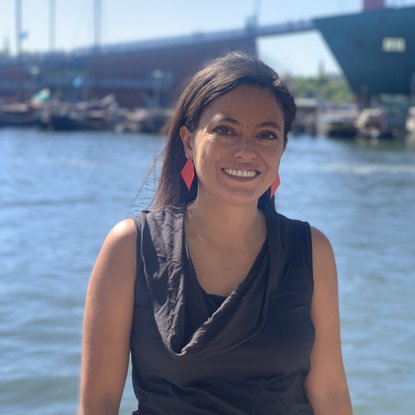
Juanita Devis Clavijo (AMS Institute) and Omar Shafqat (Amsterdam University of Applied Sciences) at the AMS Scientific Conference
ATELIER is an EU-funded research and innovation project exploring how urban neighborhoods can become Positive Energy Districts (PEDs) — areas that collectively generate more energy than they consume and actively contribute to grid stability.
In Amsterdam, two pilot sites — Republica, a mixed-use block in Buiksloterham, and Poppies, a modular housing project in IJburg — served as living laboratories. Juanita Devis Clavijo (AMS Institute) and Omar Shafqat (Amsterdam University of Applied Sciences) shared the project's most honest lessons with a room of city officials, researchers, and practitioners.
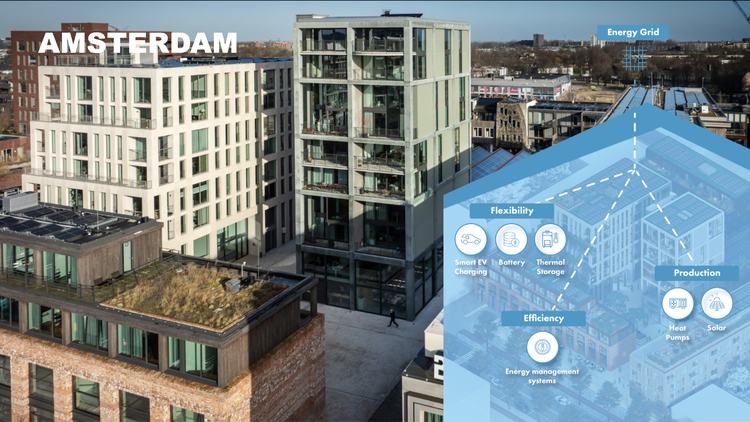
PEDs can consist of smart EV charging, thermal storage, energy management systems, heat pumps, and solar energy connected to the energy grid.
The grid problem
Republica was the more ambitious of the two pilots: six buildings, a one-megawatt battery, solar panels, smart charging, heat pumps, and thermal storage, all operating behind a single grid connection. The original plan was to use the battery to store and sell energy on the market. Then grid congestion hit. The team had applied for a two-megawatt connection — they received a quarter of that during peak winter periods.
"The battery itself is not a business model," said Devis Clavijo. The team had to pivot from market trading to flexibility management and learning that a battery only generates value when it operates across multiple revenue streams simultaneously. The battery’s original business case proved difficult to realize due to unforeseen costs and operational constraints.
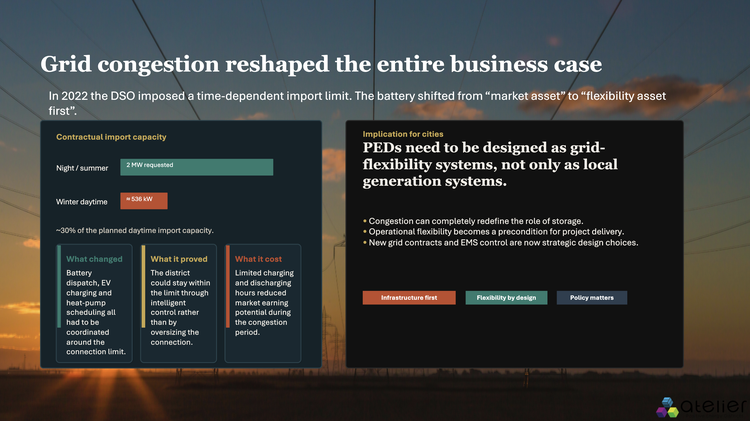
The congestion problem, Shafqat emphasized, is not unique to Amsterdam. "Account for congestion from day one," he told participants. "If it is not happening in your country yet, it is likely it will." The Netherlands, with its dense infrastructure and high demand, has become an accidental testing ground for a problem that is spreading across Europe — and the lessons are being watched closely.
Technology is the easy part
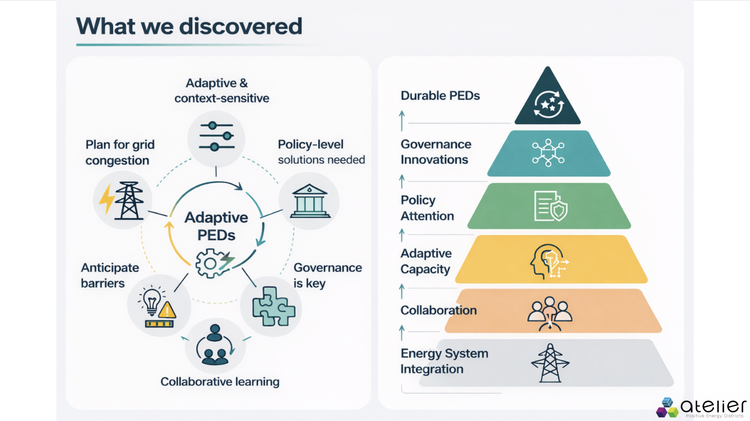
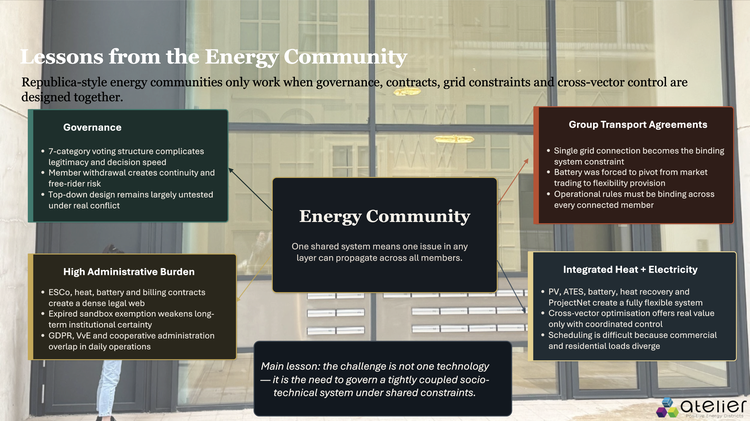
The conversation on ATELIER’s findings turned toward everything else around the technology: Governance, regulation, and business models kept emerging as the harder, slower, and ultimately more decisive challenges.
Current Energy Management Systems and other technology used in projects like Republica are often highly customized — built for one site, in one regulatory moment, for one set of partners. That makes them difficult to adopt elsewhere. Shafqat called for more generic, plug-and-play systems and for data to be made "findable, accessible, interoperable, and reusable" across providers. Without data standards, every new project starts from scratch. Ideally, energy management systems would be generic and contain software that adapts to the different types of PEDs and conditions, case by case.
Governance presented a different kind of challenge. Projects like ATELIER are typically funded for a fixed term, but the collaborations and trust, the knowledge and capacity, the innovation activities, and the policy processes they set in motion need to keep running long after the funding ends. Participants stressed that collaborative structures must be designed as long-term, evolving governance structures — not time-limited — preferably with representation from public authorities, private actors, knowledge institutions, and residents built in from the start.
Business models got direct attention among stakeholders during the discussion. Subsidies and research funding can get a project to pilot phase, but they cannot sustain it. Affordable energy for residents, access to private capital, and links with startup and innovation ecosystems are essential for durability.
From pilot to practice
The session closed with a clear sense of momentum. ATELIER's accumulated knowledge is now being packaged into practical tools for cities at different stages of the energy transition: an Innovation Atelier Guide, a PED Planning Guide, a dedicated learning platform, and a series of online courses. Keep an eye out for another publication coming soon on the Amsterdam story, which will also be found in the booklets page.

Download the PED Planning Guide, Innovation Atelier Guide, and Best Practice booklet here.
These resources are designed to make the hard-won insights from Amsterdam and Bilbao available to cities that are just starting out — so they don't have to learn every lesson the hard way.
The energy transition is coming to every city. What Amsterdam learned is that the grid, the law, and the neighbors all have to come along for the ride.
Download the PED Planning Guide