Reinventing the City: Connecting the Dots, Closing the Loops
What does it take to future-proof a city? The AMS Scientific Conference 2026 brought together scientists, policymakers, industry partners and practitioners who work on challenges our cities face right now: net congestion, housing renovation costs, the district heating transition, and much more.
Want to go deeper? Visit the Conference collection on Openresearch Amsterdam for reports, video recordings of the opening speeches, keynotes, and panel talks, as well as a series of knowledge articles about the full program.
Day One: Unexpected Connections
The conference kicked off with opening remarks from Eveline van Leeuwen, AMS Institute's Scientific Director, and Ger Baron, Director of Digital and Innovation at the City of Amsterdam.
“Today, we gather to reinvent our cities, connect the dots between different disciplines and individuals who often work in isolation, and close the loops to make our cities more resilient, regenerative, and just. This conference is an invitation to work together, to collaborate, and to see the city as a truly valuable living system.”
Eveline van Leeuwen
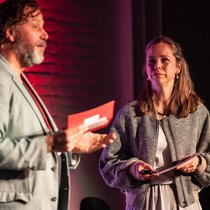
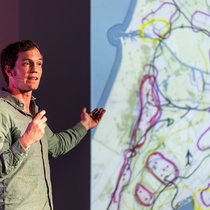
They were then joined by Anáclaudia Rossbach, Executive Director of UN-Habitat, via a live connection. In her keynote interview, Rossbach drew on decades of experience, from São Paulo’s communities to global institutions, to frame cities as the frontline where climate shocks, inequality, and housing shortages converge. Here, informal settlements vividly illustrate both vulnerability and ingenuity. She argued that solving the urban crisis requires more than isolated projects: it demands systemic change, laws, data, financing, and governance. Afterward, Peter Pelzer took the stage with an inspiring keynote on how we can develop what he calls 'rooted imagination,' an urban imagination that is both transformative and grounded.
“Finding unusual connections and unexpected dots is not only about the radical ideas out there, but it's actually about connecting your imagination of the future to what you do in your daily life and existing systems today.”
Peter Pelzer
After a short coffee break, Peter Pelzer was joined by Pietro Reviglio (Eurocities), Jan Duffhues (City of Amsterdam), Antonia Wormer (Blade-Made), and Aline Machado Da Matta (UN-Habitat) for a panel talk, focused on identifying and connecting new or unexpected dots to facilitate resilient, regenerative, and just cities.
After lunch, the conference continued at the Marineterrein where many parallel sessions invited participants to exchange knowledge and perspectives. The day came to a close with the official handover of the Climate Adaptation Knowledge Agenda from Eveline van Leeuwen (Scientific Director, AMS Institute) en Doutje Lettinga (Chief Science Officer, City of Amsterdam) to Nout Verhoeven (Municipal Director of Public Space, City of Amsterdam) and Henriëtte de Vos (Director of Water at the Water Authority of Amstel, Gooi and Vecht).
Day Two: Closing the Loops
The conference started with opening remarks on 'Closing the Loops' from Stephan van Dijk, Director of Innovation at AMS Institute and Hester Bijl, Rector Magnificus at TU Delft. Through concrete examples, from circular asphalt and canal wall renovations to failed plastic recycling ventures, they sketched a landscape where technical ingenuity alone is not enough. As Bijl puts it, engineers must become bridge-builders across domains, while Van Dijk called for collective intelligence and persistence. The invitation to the audience is clear: work across boundaries, learn from failure, and turn fragmented innovation into systems.
In her keynote, Catharina Bening dismantled the comforting narrative of circularity as a neat technical fix, instead exposing a world where wind turbine blades, plastics, buildings and textiles circulate through messy systems shaped by markets, regulation and human habits.
“Circular economy is everywhere in the debate, yet global resource consumption keeps rising, waste is growing, and most solutions remain partial – there is no silver bullet. Unless we address systems, behaviour and politics together, closing loops will not deliver the impact we are hoping for.”
Prof. Catharina Bening
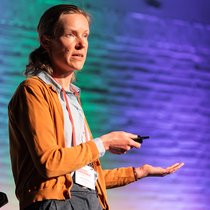
Then Diederik Samsom took the stage, delivering a powerful address on sustainable cities as a social challenge.
“In order to change society we need technologies, financial systems, and the reform of fossil fuel subsidies. But most of all, we need to focus on people’s lives. Their hopes, their perspectives, and their optimism. And that happens in cities. It is within cities that two challenges – creating a sustainable future and improving people’s lives – come together.”
Diederik Samsom
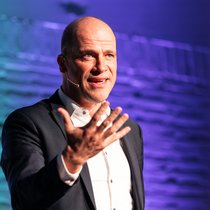
After the break, Prof. Catharina Bening returned to the stage, joined by Prof. Katrien Termeer (Wageningen University & Research), Mats Siffels (Amsterdam Donut Coalition), and Erik van Doorn (Dura Vermeer) for a panel on implementation and scale-up. The discussion focused on how researchers, companies, and governments can better connect the dots to accelerate progress in circularity and the energy transition.
► Re-watch this panel and other sessions on Openresearch Amsterdam.
Across the Marineterrein, the afternoon program opened up into parallel sessions on urban heat adaptation or food waste, the sustainable pathways game, or a workshop on testing dashboard indicators. The day came to a close with an urban dance performance by sustainability engineer and Indian classical dancer Gayathri Angou. She not only offered an astonishing physical interpretation of the layered and ever-evolving character of cities, but furthermore contextualized the importance of creativity in complex city challenges.
Day Three: Breaking Boundaries
The conference drew to a close after three days of insights, exchange, and encounters that together shaped a shared sense of momentum. This day was all about 'Breaking the Boundaries', starting with opening words by AMS Institute Managing Director Zwanet van Lubek and Ewout Runhaar, Chief Data Officer at City of Amsterdam. The first keynote speaker, James Evans (University of Manchester), reflected on the pilot paradox: successful experiments don't add up to systemic transformation.
Replication fails not because the technology doesn't work, but because structural constraints and cultural fit differ city to city — illustrated vividly by Manchester's six-year struggle to install four floating bus stops; a common practice across Northern Europe. The magic bullet model of "demonstrate, monitor, replicate" simply doesn't always hold. The countermodel is organisational learning: deliberately designing living labs to build institutional capacity, connect departments, and change cultures from within.
Babette Porcelijn delivered the final keynote of the conference. She argued that while the richest two percent extract value upward, the poorest half of humanity absorbs the consequences. Her proposed 'trias economica' draws on an old idea: the separation of power. Crucially, decision-making would shift away from those who merely own the most, toward all those who actually bear the consequences: workers, local communities, consumers, nature, and future generations.
“Our political system is democratic, but our economy is not. Imagine an economy that works for everyone: people here and elsewhere, now and in the future. Yes, it's going to be hard – but we have to change, otherwise it's going to be even harder. And we are running out of time.”
Babette Porcelijn
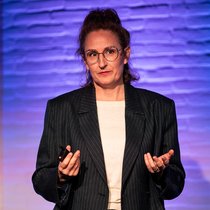
How can we better connect the dots among stakeholders? How can we truly close the loops to ensure knowledge and innovation reach everyday life? And how can we reinvent cities, in particular in places hit by disasters? These were the questions at the heart of the final panel that brought together our keynote speakers as well as Prof. Tamara Metze (Delft University of Technology), Roos Dors (Women on Food), and Ewout Runhaar (City of Amsterdam).
► Re-watch this panel and other sessions on Openresearch Amsterdam.
After a healthy lunch it was time to disperse across the Marineterrein one last time, where attendees participated in sessions surrounding food systems, scaling knowledge to energy pilots, accessible cities, and a crash course on Living Labs. The day came to a festive closing with the celebration of early-career scientists through the Young Scientist Award ceremony, recognizing outstanding research and promising contributions to the field. Congratulations to Olivia Willems, Yifan Yang, and Zian Wang! The award highlights the importance of supporting emerging talent and fostering the next generation of researchers driving innovation and impact within the field. Afterwards, a reflective contribution by AMS philosopher Geert van Zandbrink was offered. And of course, there were some drinks to toast to a beautiful three days!
This only skims the surface of the many sessions, speakers, and expert talks. Visit the Conference collection for reports, video recordings of the opening speeches, keynotes, and panel talks, as well as a series of knowledge articles about the full program on Openresearch Amsterdam
Want to stay tuned for future updates on the AMS Scientific Conference? Sign up for the newsletter here.
A heartfelt thank you goes out to all our speakers, panelists, participants, staff, and attendees. Your contributions made this conference an unforgettable experience. We'd also love to extend our gratitude to our partners: City of Amsterdam, TU Delft, Wageningen University and Research, and MIT Senseable City Lab.