Amsterdam is working towards a future-proof city. One with sustainable infrastructure, smart technology, and dedicated space for experimentation. But that kind of transformation requires people who can connect researchers, municipalities, contractors and communities around a shared challenge, and guide them through a process of co-creation and learning. That's exactly what a Living Lab Coordinator does.
At AMS Institute, Living Lab Coordinators are at the heart of our Urban Living Labs. In these real-life environments, new solutions are designed, tested, and scaled in collaboration with the city. Unlike traditional project managers, the role of a Coordinator is dynamic and adaptive, shifting to meet whatever the Living Lab needs at any given moment.
Watch the video below to hear it directly from two of our AMS Living Lab Coordinators about their work for Leerlab Infra, a learning environment for infrastructure innovation.
What Does a Living Lab Coordinator Actually Do?
In this video, Anke van Gelderen and Tom McDevitt explain how they guide a process of co-creation: designing and facilitating experiments that address real infrastructure challenges, engaging diverse stakeholders, and connecting knowledge and practice so that everyone - contractors, municipalities, researchers - can learn from each other.
In De Nieuwe Straat for example, they explore predictive maintenance using AI, experiment with new contract models and collaborative ways of working, and model tree roots to support a greener city. By sharing these insights beyond the pilots, they help accelerate innovation across the entire infrastructure sector.
“Coordinating a Living Lab isn't a fixed job. It's a dynamic role that adapts to what is needed at the moment. Sometimes it's about building networks and trust. Sometimes it's about facilitating dialogue or solving practical problems. And other times it's about translating local results into policy or broader urban programs. But at its core, it's about connecting - people, projects, and different scales of work.”
Anke van Gelderen
Living Lab Coordinator
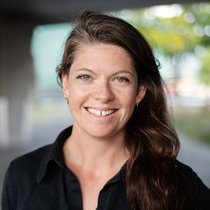
Living Lab Coordinators are active across AMS Institute's portfolio of Urban Living Labs. Michelle Molema, for example, coordinates the Living Lab Clean City Center a project focused on waste management in Amsterdam's city center.
“As a Living Lab Coordinator, I work with scientists and the people who actually work in the city center. Employees of the municipality of Amsterdam, but also entrepreneurs, residents and visitors of the places where the problem arises. I see my role as being the bridge between the theory and the practice, translating the different languages the different stakeholders speak and making sure we set up research that produces relevant outcomes.”
Michelle Molema
Living Lab Coordinator

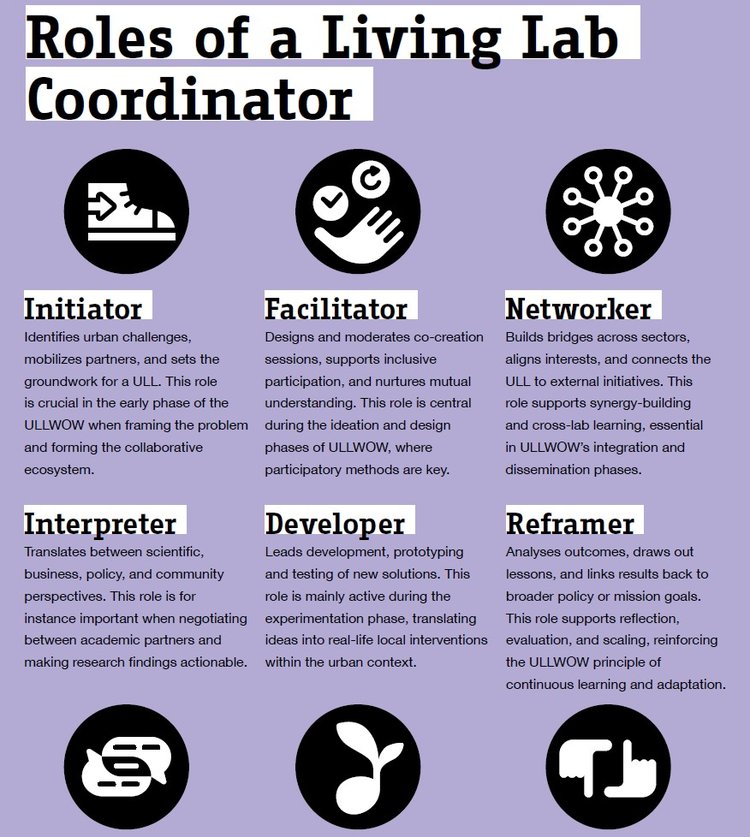
Six Roles, One Coordinator
The Living Lab Coordinator shifts fluidly between different roles depending on the phase and needs of a Living Lab. This flexibility is the strength of the role. A Living Lab Coordinator doesn't just manage a project. They hold the ecosystem together. At the core of this is a generalist mindset, the ability to oversee and understand each stakeholder's interests without losing sight of the shared end goals.
What Does It Take?
Effective coordination of a Living Lab draws on a mix of skills, mindset, and strategic ability. Core competencies include system thinking, facilitation and co-creation, innovation and experimentation, and the ability to translate knowledge across stakeholder groups. But mindset and soft qualities matter just as much: empathy, adaptability, resilience in the face of uncertainty, and a genuine orientation towards reflection and learning. And strategically, a coordinator connects local experiments to larger urban transitions, builds trust between partners over time, and thinks across multiple scales - from the street to the city system.
Working Side by Side: The Mediator of Innovation
The Living Lab Coordinator doesn't work alone. In De Nieuwe Straat, they collaborate closely with another key role: the Mediator of Innovation, typically fulfilled by someone from the municipality or a contractor. Where the Living Lab Coordinator steers the overall process of co-creation and learning, the Mediator of Innovation focuses on what it takes to make collaboration work inside complex projects: aligning different interests, keeping shared goals visible, and creating the conditions for experimentation. This complementary dynamic between the Living Lab Coordinator and the Mediator of Innovation is what makes the approach powerful. One holds the bigger picture of the lab; the other holds the human and organizational fabric of the project. Together, they turn experimentation into real change.
An Invitation to Co-create
The Living Lab Coordinator role is part of AMS Institute's Urban Living Lab Way of Working: a structured approach to co-creating systemic urban innovation with partners from government, industry, and knowledge institutions. This is developed and supported by AMS Institute's Urban Impact Team, which works with partners to embed the Urban Living Lab Way of Working across different urban domains from infrastructure and mobility to public space and the circular economy.
Download the Urban Living Lab Way of Working Handbook
We want to invite professionals - contractors, municipalities, researchers, and knowledge workers - to make use of this approach and take on one of these roles themselves.
Want to learn more or get involved?
Leerlab Infra (in Dutch) supports co-creation, experimentation, and the scaling of innovative solutions in the infrastructure sector. This platform offers knowledge, tools, and training to help you get started with the Living Lab Way of Working in the role of coordinator or mediator.